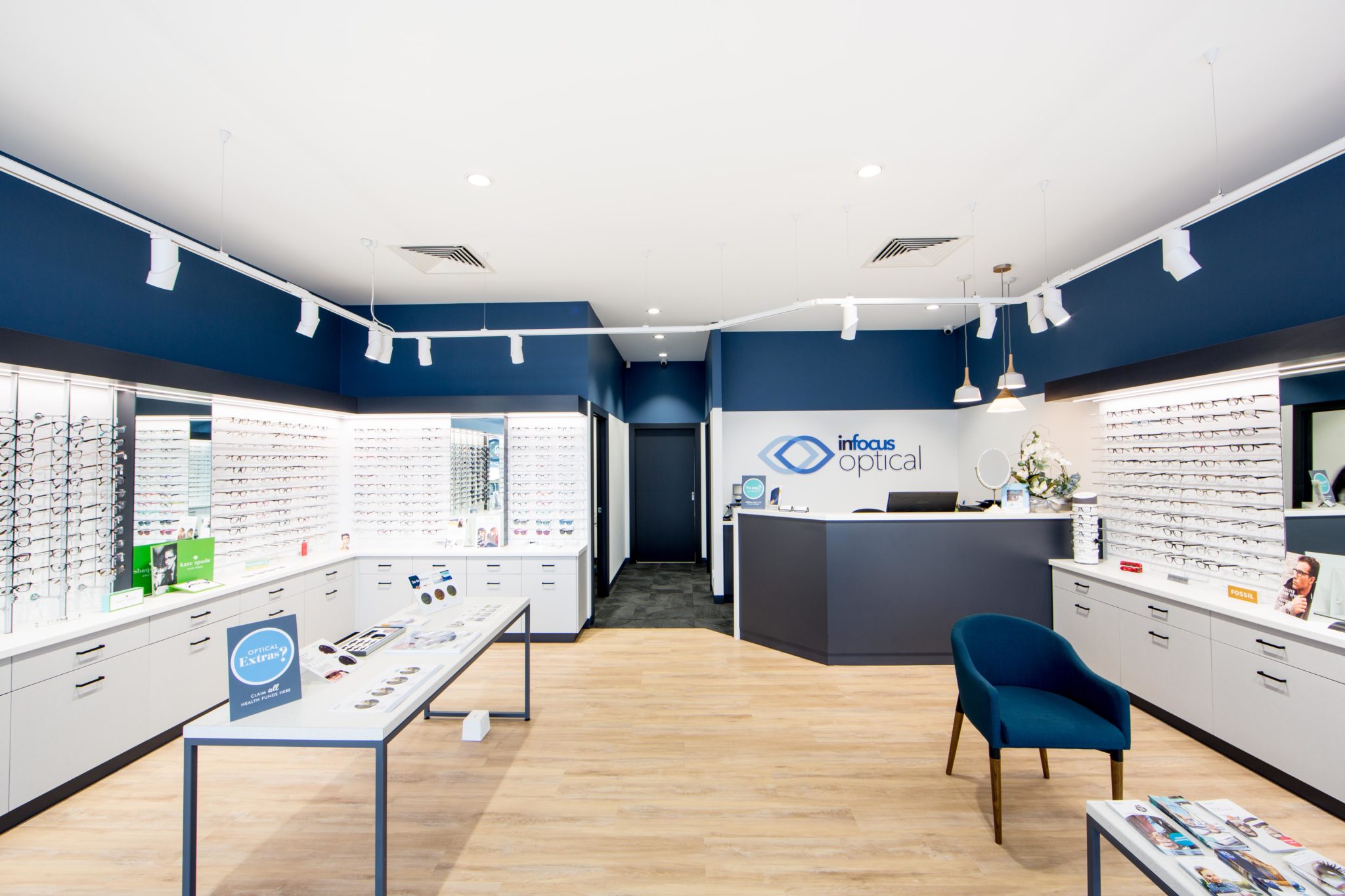
When designing for a retail store, the lighting you select can be an important component to your brand strategy. A store’s lighting can influence a customer’s decision to enter the store, determine how long they spend there and impact their purchasing behaviour. There are different lighting strategies and styles to achieve a variety of shopping experiences.
Here are some guidelines to determine the best type of lighting for each retail zone:
Window Displays & Shopfronts
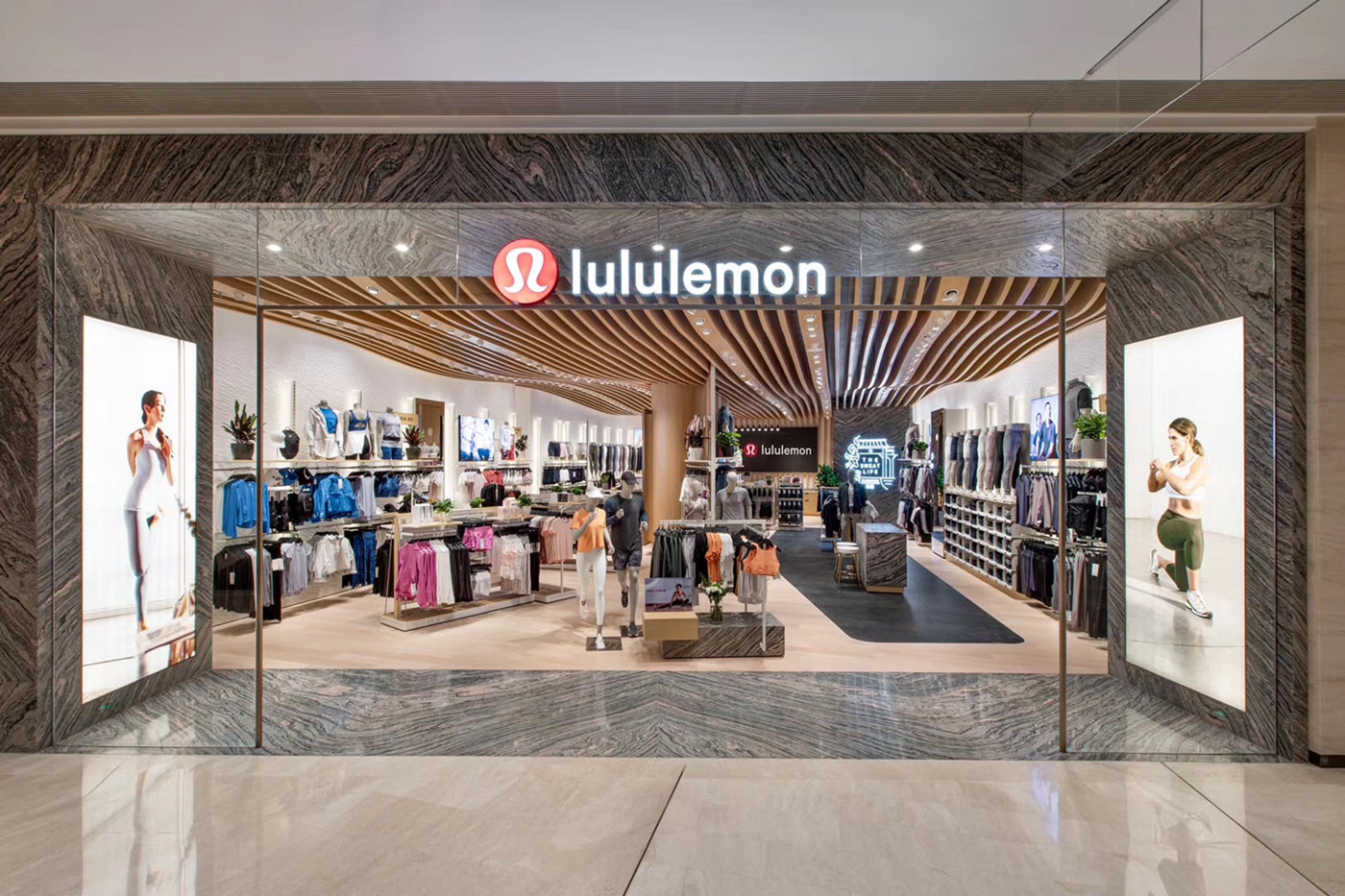
First impressions count when it comes to the window displays of a store. We want to excite customers, draw them in and keep them engaged. A shopfront that is visually appealing and informative is a great way to catch the eye of passers-by and let them know what kind of goods and services to expect. A key consideration for this space is versatility and contrast. Window displays are constantly changing to keep consumers engaged. We recommended adjustable track lights, decorative pendants or adjustable downlights to create a variety of display options.
Checkout Registers & Point of Sales Stations
The checkout registers are key zones for customers as they make a purchase. Consider low-glare task lighting to avoid glare from the screens as staff carry out transactions in an efficient manner. It’s also a good opportunity for impulsive last-minute buys, so ensure the product displays are well illuminated at the counter.
Visual Merchandise & Product Displays
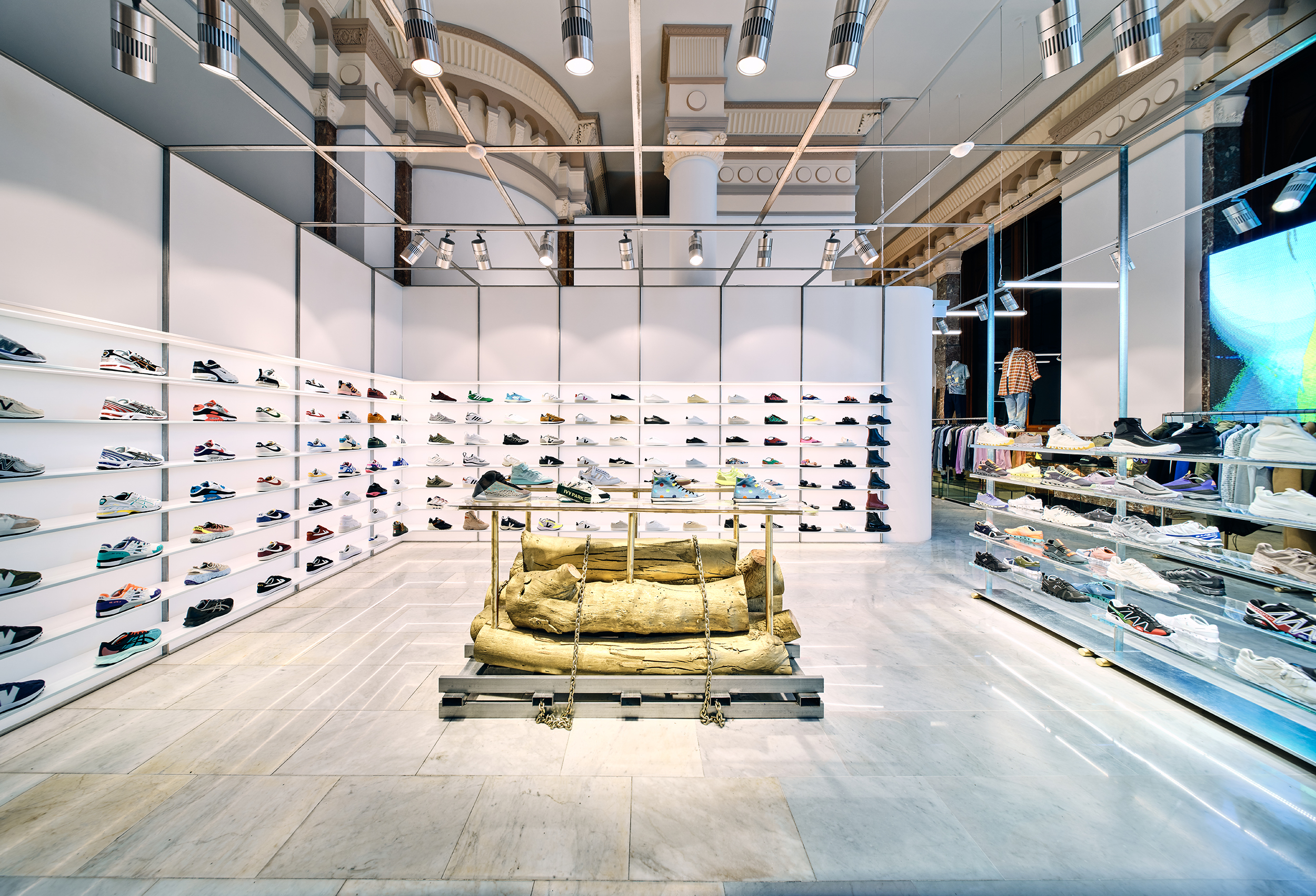
Using multiple sources of light in your retail store allows you to create contrast among your products. We recommend using accent lighting and backlighting to indicate the importance of products to customers. They are able to see the details of the product up close and keep customers lingering there. When placed strategically, they can guide the customer’s eye to where you want them to go. The illuminance level for accent lighting is typically higher than those used in general lighting areas. Consider adjustable track lights, cabinet and shelving lights and wall lights for product displays. The placement of displays also plays an important part in your store design. If you want to encourage your customers to venture deeper into the store, place them in the middle or towards the back.
Sales Floor
Lighting can brighten up the sales floor experience for customers. It can determine the ambience of the store and craft customer sentiment. Customers should feel comfortable and relaxed in the space. We recommend creating contrast but uniformed lighting for large sale floor areas. It can guide customers around the store to focus on your key merchandise. Wall washing is another great option to create a sense of space and depth.
Fitting Rooms
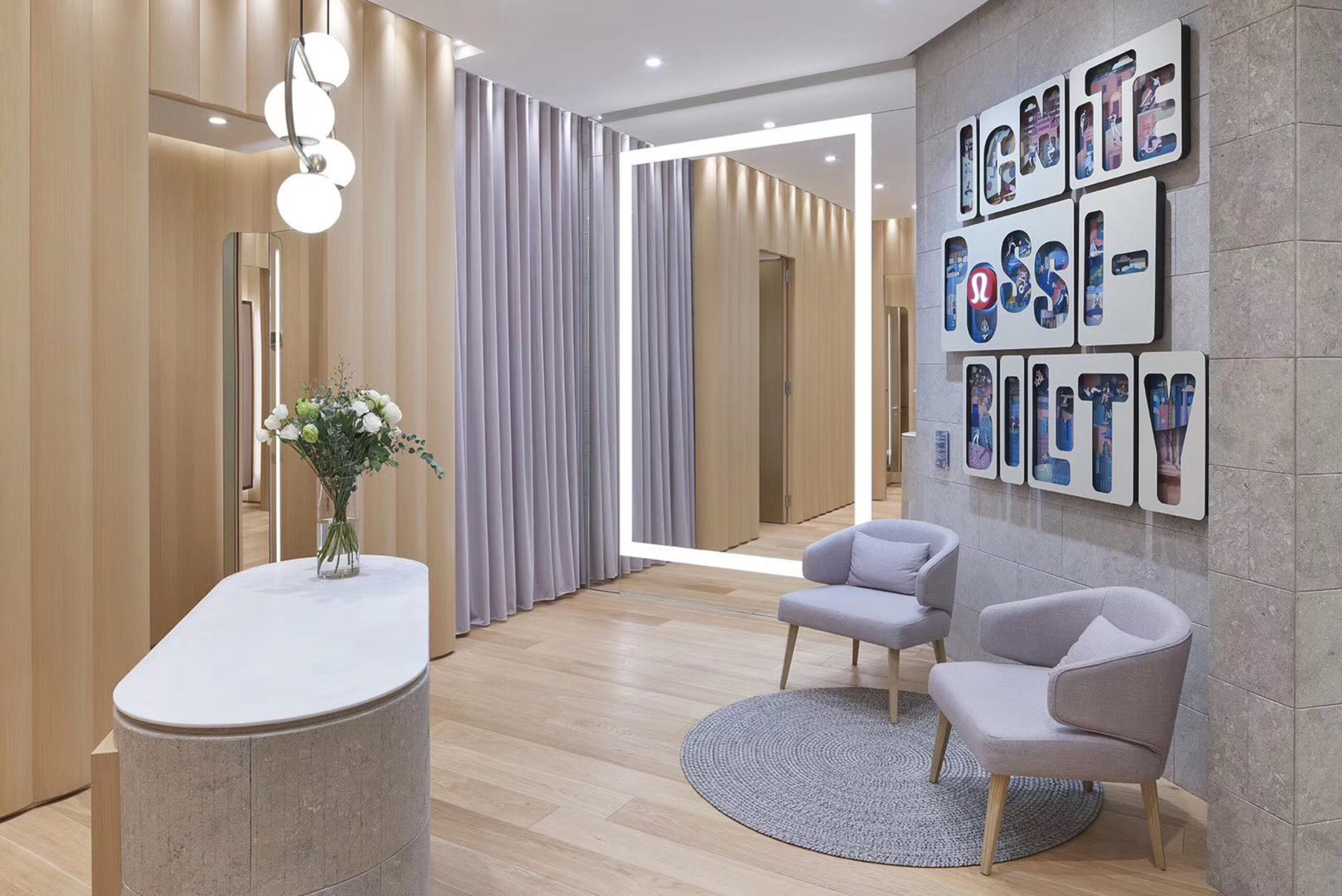
Often one of the most neglected zones, fitting rooms can be uncomfortable confined spaces with little to no natural light. The lighting should be flattering and create a positive experience for customers as they’ll evaluate whether to purchase the item or not. Colour rendering is crucial when it comes to fitting rooms. A recommended CRI<90 in a warmer colour temperature is best to accurately depict the colours of the item. Using a combination of front lighting illuminates the customer’s vertical planes while a wider illumination from above to provide ambient lighting is ideal. Indirect lighting can also help to soften the shadows and shape the body in a flattering light.
Back of House
The back-of-house area is just as important as any other retail space. Look for low-glare task lighting that’s ideal for office spaces and storage rooms. This will allow staff will be able to accomplish their work effectively. In supermarket stores with food preparation or refrigeration rooms, it’s important to ensure the luminaires installed meet food standards.

Have you ever walked into a store and noticed how some products look more vibrant and appealing under certain lights, while others seem dull and unattractive? The secret behind this visual phenomenon lies in a crucial lighting measurement called the Colour Rendering Index (CRI). As technology advances and customer expectations grow, retailers are becoming increasingly aware of the significance of CRI and its indispensable role in creating captivating shopping experiences.
Unravelling the Colours and Textures
Colour Rendering Index (CRI) is a measurement used to quantify how accurately a light source represents colours when compared to natural light. CRI is scored on a scale of 0 to 100, with a higher CRI indicating better colour rendering capabilities. When the CRI is closer to 100, the colours and textures under that light source appear more vivid and lifelike. Conversely, lower CRI scores result in colours that may appear distorted, washed out, or less true to their actual hue.
Primary Colours and the R9 Value
CRI measurement can sometimes be misleading, especially when it comes to primary colours. To gain a better understanding of colour rendering, we need to pay special attention to a specific colour within the CRI spectrum – reds. Reds are known to be the most difficult and expensive colours to render accurately. As such, it is crucial to check the R9 value when assessing lighting quality. The R9 value represents the rendering of red hues, and a value higher than 60 is a promising indicator of vivid reds.
Striking the Perfect Balance
While we strive for higher CRI scores to achieve impeccable colour rendering, there is a trade-off to consider. The higher the CRI of a light source, the lower its output will be. The good news is that advancements in lighting technology have significantly narrowed this gap. Today, the difference in output between CRI<70 and CRI<90 is approximately 10%, making high CRI lighting more accessible and practical for various applications.
CRI in Different Environments
The ideal CRI value depends on the specific application and environment. In office settings, where colour precision is crucial for tasks and productivity, CRI<80 is typically considered acceptable. However, as we delve into the realm of retail, where visual merchandising and customer experiences reign supreme, a higher CRI<90 is preferred. This ensures that products look their best, encouraging customers to linger and explore.
In environments such as car parks and warehouses, they prioritise functionality and efficiency over colour precision. For these applications, a CRI<70 or higher is considered adequate, as the primary concern lies in providing ample illumination for safety and convenience.
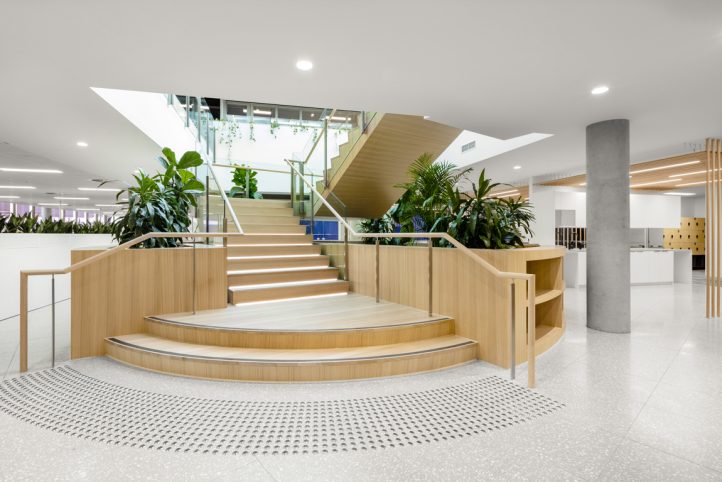
Sustainable design is increasingly becoming an integral part of our lives. LPA recognises the environmental impact businesses have on our planet. By partnering with brands achieving the same goals, being adaptable with our service offerings, sourcing products and creating lighting solutions that promote sustainability, we are doing our part to support the world’s change for a better future.
With our experienced team of designers, we focus on providing lighting solutions that minimise our environmental footprint. Our lighting designs are influenced by industry trends in architecture, interior design and lighting design. We work with our clients to analyse and find efficiencies in their design plans to contribute to their energy optimisation. Our team are able to communicate their lighting concepts through sketches, computer renders and detailed 2D and 3D documentation in a virtual space.
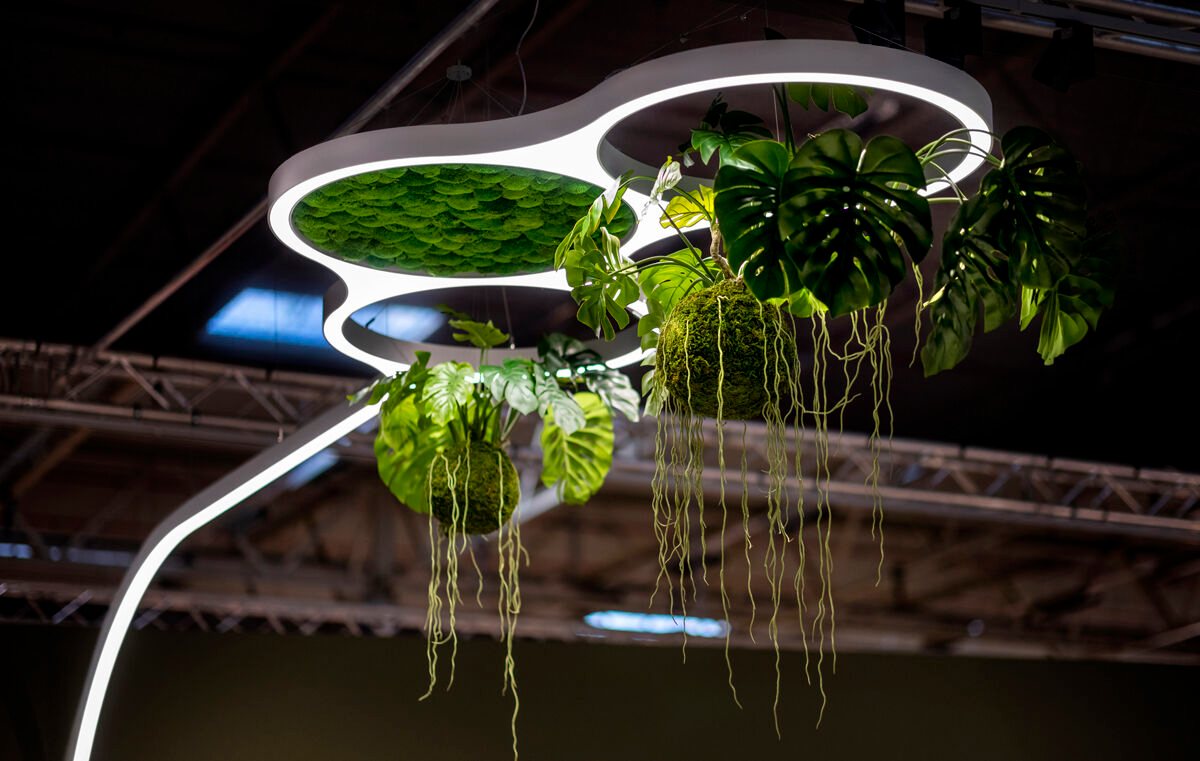
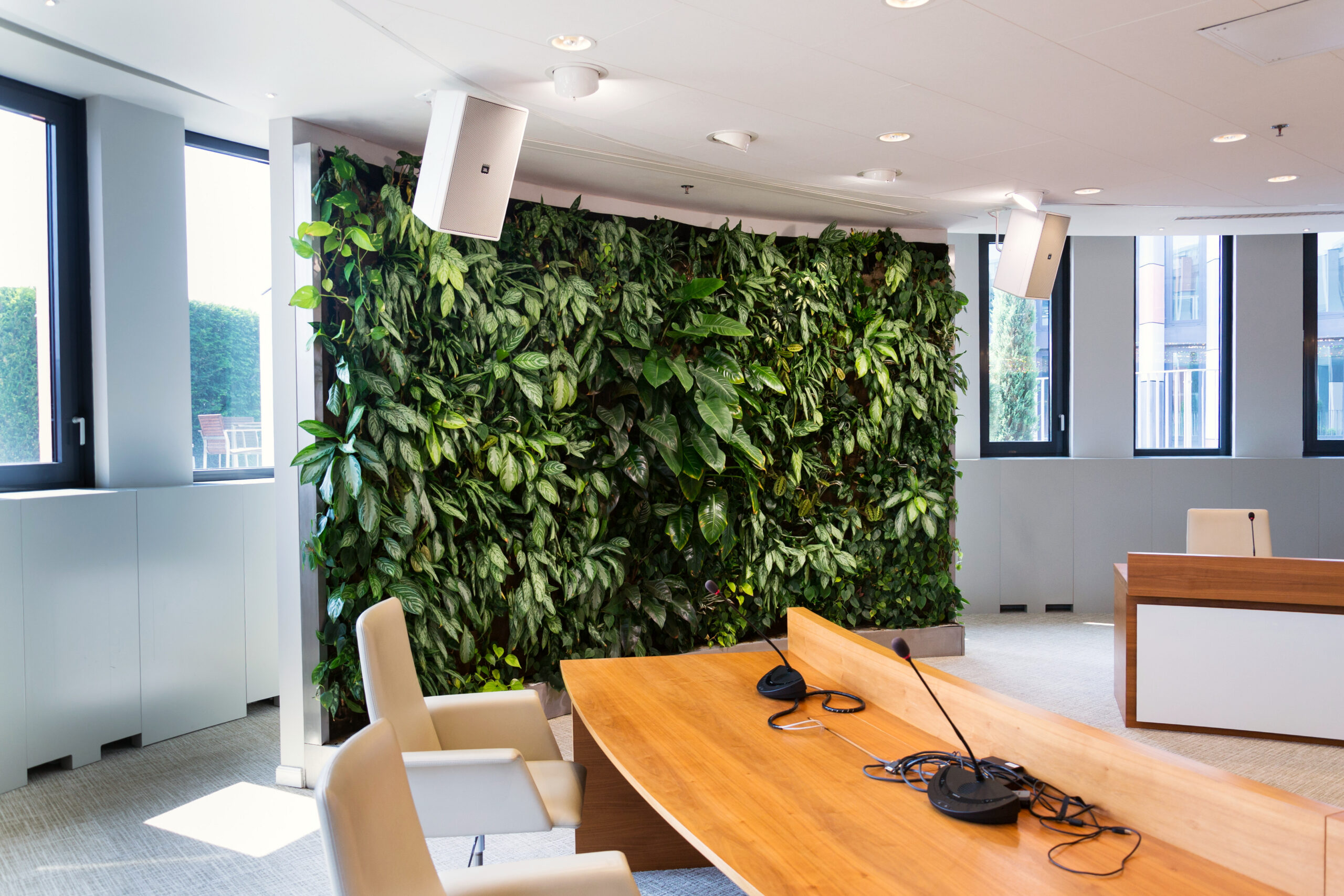
The use of natural light, reflective surfaces and additional elements such as green walls play a fundamental part in our design and the overall goal of reducing energy consumption. Clever design matched with good technology can reduce the need for artificial lighting – decreasing energy use in a building by 50-70%.
We design using luminaires that have a long life, are efficient, are repairable and replaceable without compromising on quality. Our products can be reused or recycled at the end of their life cycle. With the integration of smart technology, our team can utilise separate controls on individual areas allowing the use of motion and occupancy sensors to be implemented and reduce energy consumption.

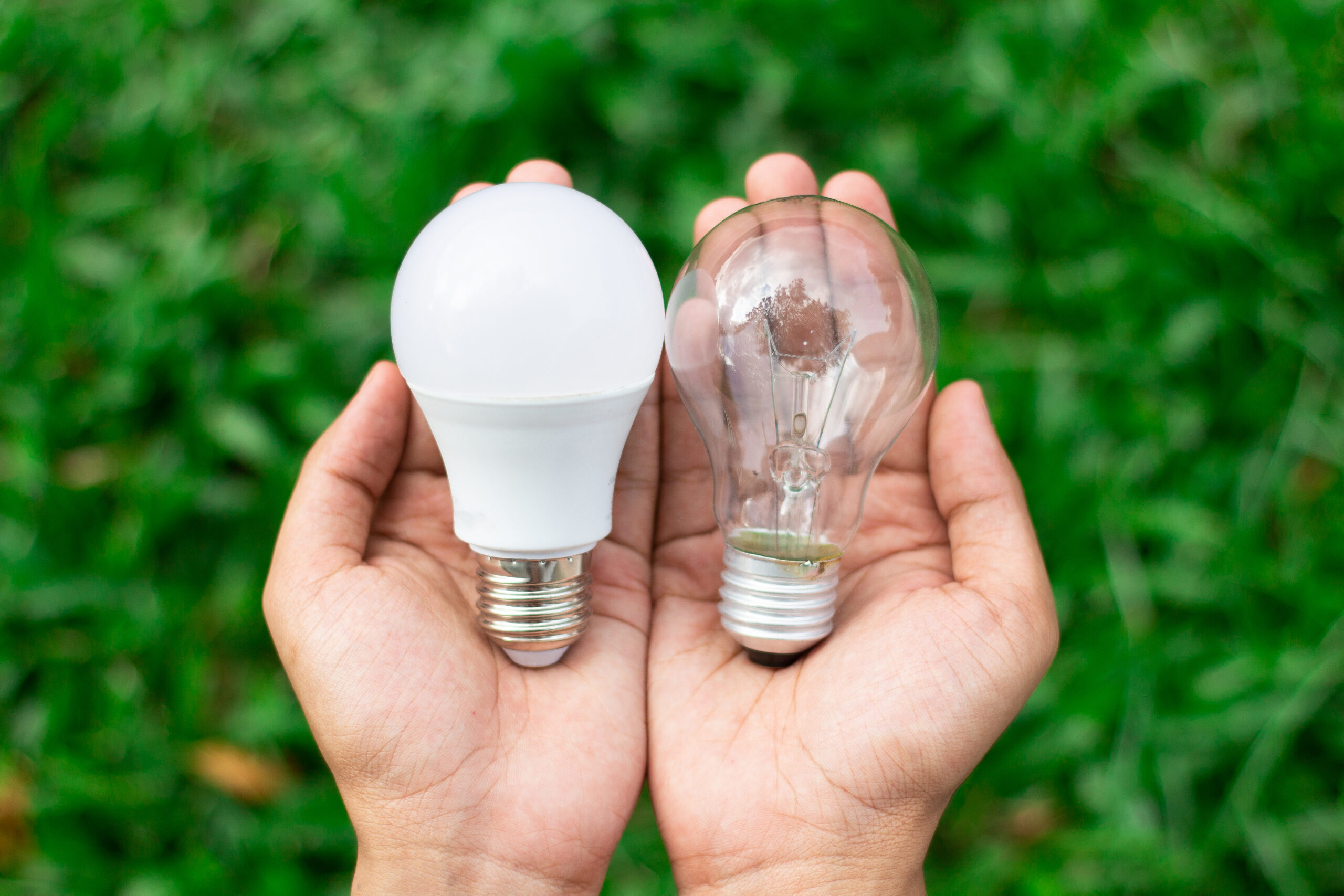
LED lighting has revolutionised the way we illuminate our spaces. Compared to traditional incandescent bulbs, LEDs offer superior energy efficiency, longer lifespans, and cooler operation. But within the world of LEDs, there’s a further level of optimization to be achieved: high-efficiency chips.
What are High-Efficacy Chips?
At the heart of every LED lies a tiny semiconductor chip. This chip converts electrical energy into light energy, measured in lumens. Efficacy, expressed in lumens per watt (lm/W), tells us how efficiently this conversion happens. The higher the lm/W rating, the more light an LED chip produces for each watt of electricity consumed.
High-efficacy chips are the champions of this metric. Currently, they can achieve lm/W ratings exceeding 200, and research suggests even higher values are on the horizon. This translates to significant energy savings, making them a compelling choice for a variety of lighting applications.
Benefits of High-Efficacy Chips
Reduced Energy Consumption: The most apparent benefit is the substantial decrease in energy used. High-efficacy chips require less power to produce the same level of light compared to standard LED chips. This translates to lower electricity bills and a smaller carbon footprint.
Lower Heat Generation: LEDs already generate less heat than incandescent bulbs. High-efficacy chips take this a step further by minimizing heat production even more. This not only improves the overall lifespan of the LED fixture but also eliminates the need for bulky heat sinks, leading to sleeker and more aesthetically pleasing designs.
Longer Lifespan: Heat is a major enemy of LEDs, accelerating their degradation. Since high-efficiency chips generate less heat, they tend to last longer than their standard counterparts. This translates to fewer replacements and lower maintenance costs.
Improved Light Quality: High-efficacy chips don’t compromise on light quality. They are available in a wide range of colour temperatures and with excellent colour rendering index (CRI) ratings, ensuring vibrant and natural-looking light.
Applications for High-Efficacy Chips
The energy-saving potential of high-efficacy chips makes them ideal for various applications:
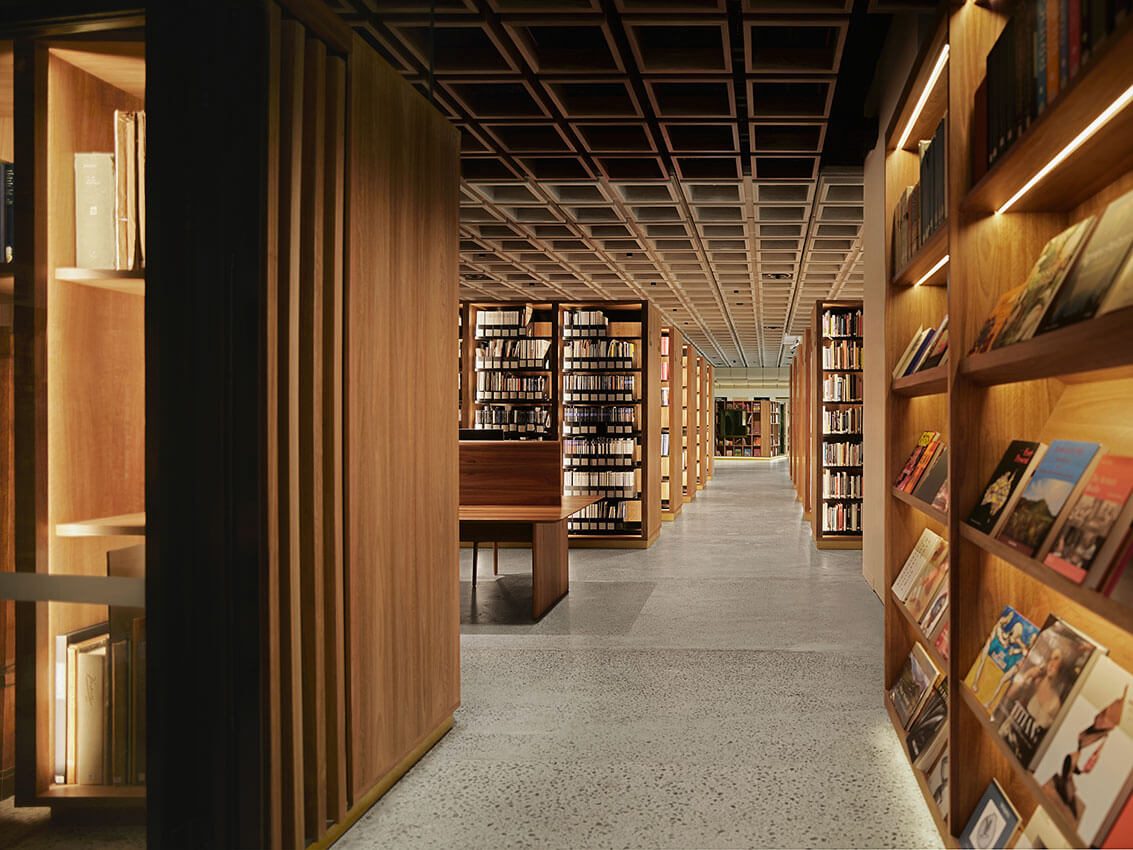
Commercial Lighting: Offices, warehouses, and retail spaces can significantly benefit from the reduced energy consumption offered by high-efficacy chips.
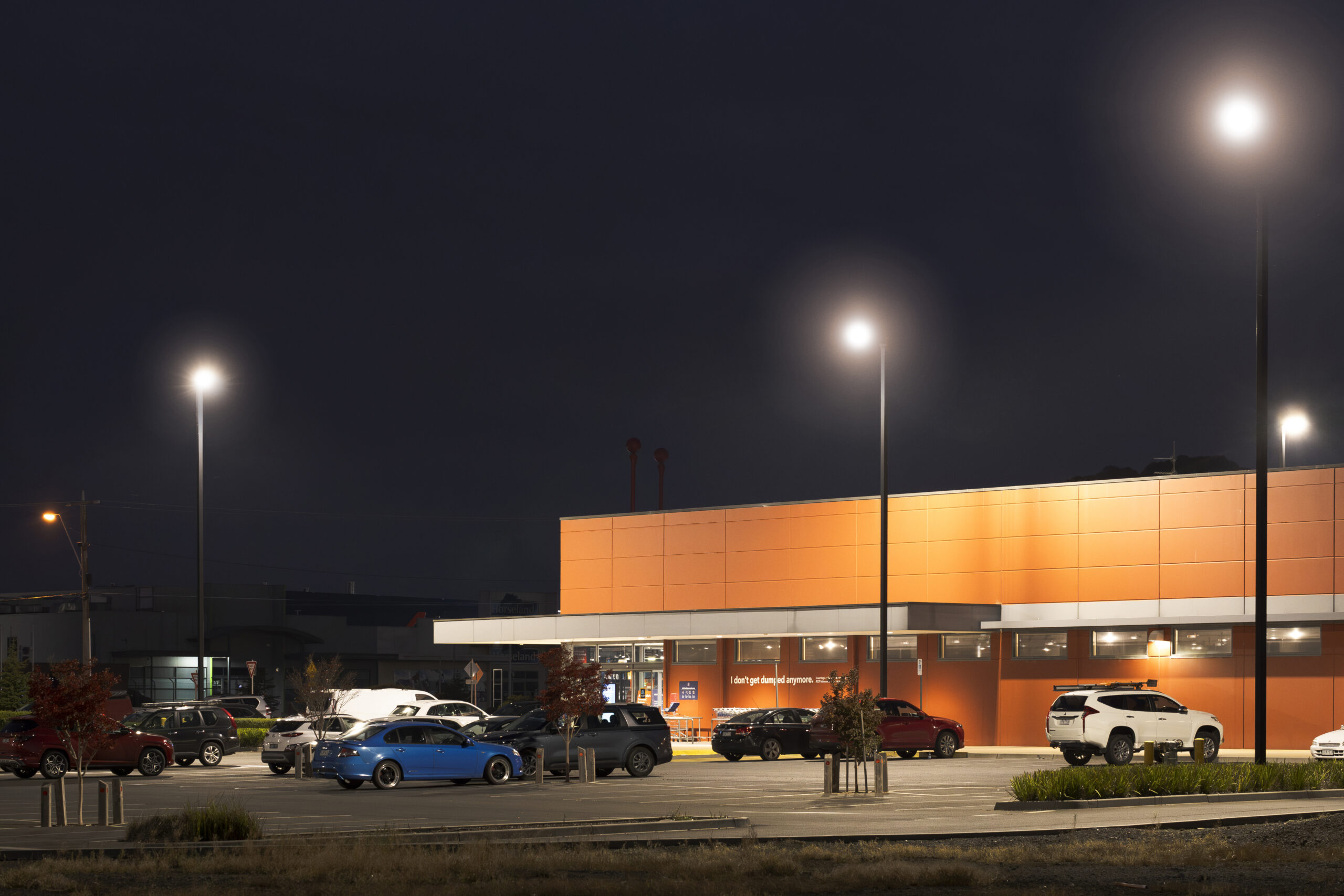
Street Lighting: High-powered LED streetlights equipped with these chips can illuminate roads and walkways efficiently, promoting safety and environmental responsibility.
Downlights and Panel Lights: These fixtures are commonly used in commercial and residential settings. High-efficacy chips can contribute to dramatic energy savings in these applications.
Task Lighting: Task lights provide concentrated illumination for activities like reading or working on a computer. High-efficacy chips can ensure adequate light levels while keeping energy use low.
Choosing High-Efficacy LED Lighting
When selecting LED lighting, look for fixtures that specify the lm/W rating of the chips used. Opt for options with ratings exceeding 150 lm/W to ensure high efficacy. Remember, a higher initial investment in high-efficacy chips can be offset by significant energy savings over the lifespan of the fixture.
The Future of High-Efficacy Chips
Research and development in LED technology are ongoing. Manufacturers are constantly striving to push the boundaries of efficacy. As the technology matures, we can expect even higher lm/W ratings, making LED lighting even more efficient and cost-effective.
In conclusion, high-efficiency chips represent a significant advancement in LED lighting technology. By prioritizing energy savings, longer lifespans, and cooler operations, they pave the way for a more sustainable and efficient future of illumination. So, the next time you’re considering LED lighting, look for options featuring high-efficiency chips to experience the brightest and most responsible way to light your world.

Lighting Design to Reduce Energy Consumption
At LPA, our internal design team comes from varying backgrounds architectural, engineering, design, and lighting itself. With their extensive knowledge and industry understanding a passion for lighting is apparent. LPA’s global footprint and shared services model empower us to cater to both global design needs and regional requirements. By adhering to four key principles—lighting product, lighting design, smart controls, and data monitoring and management—LPA establishes holistic and highly efficient lighting systems. These systems not only reduce energy consumption but also promote sustainability and cost-effectiveness for our clients.
Lighting Technologies for Designers:
Li-Fi (Light Fidelity)
- Uses LED bulbs for high-speed data transfer through visible light communication.
- Enables integrated lighting and data connectivity within spaces.
OLEDs (Organic Light Emitting Diodes)
- Offer thin, flexible, and sometimes transparent light sources.
- Allow for creative integration into architectural elements for unique aesthetics.
Advanced Control Systems and Integration:
Smart Controls and IoT Integration
- Enable sophisticated lighting systems adjusting based on real-time data.
- Personalise lighting experiences according to user preferences and environmental conditions.
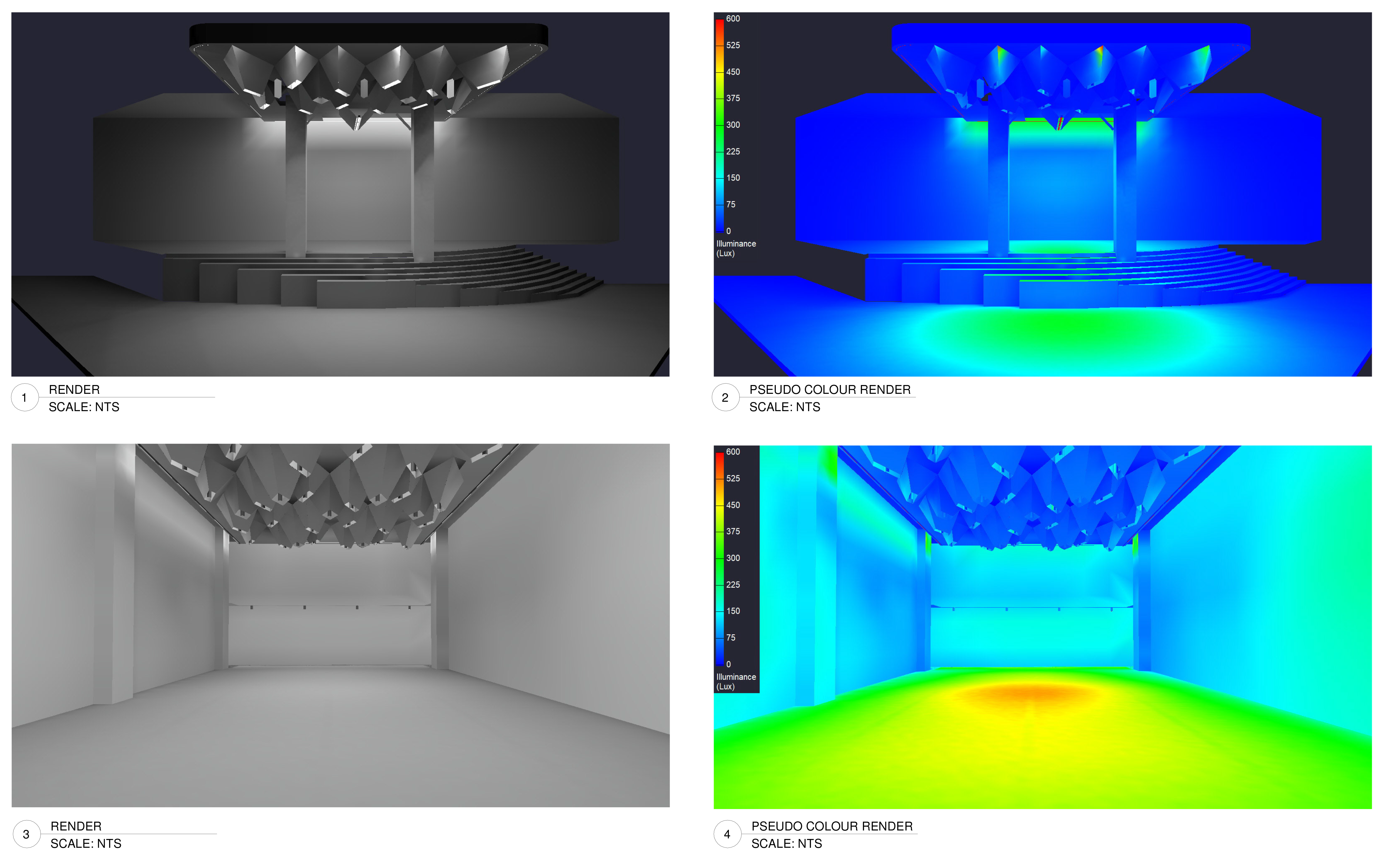
BIM (Building Information Modeling) and Photometric Software “AGI”
- Assist in simulating and analyzing lighting conditions in spaces.
- Integrate lighting plans seamlessly into overall architectural designs for coherence and efficiency.
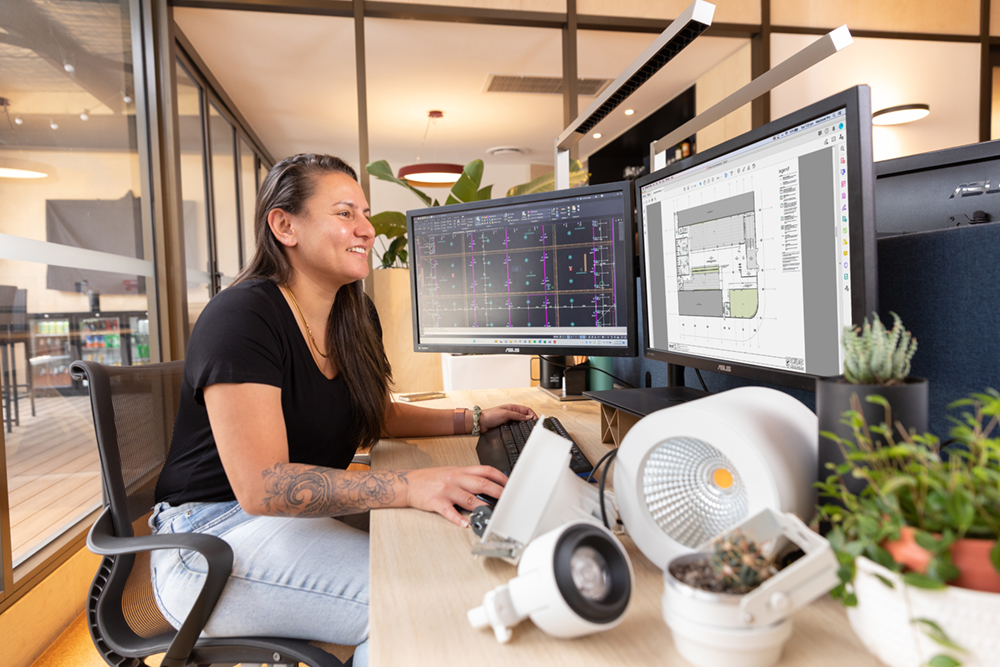
Lighting Design
Our lighting designers use several technologies to create efficient lighting plans. Photometric software plays a crucial role, allowing designers to simulate and analyse lighting conditions in a space. This software helps in predicting how light will behave in different areas, considering factors like intensity, distribution, and colour. Additionally, Building Information Modeling (BIM) software enables designers to integrate lighting plans into overall architectural designs, ensuring coherence and efficiency in the use of light within a space. Advanced sensors and controls aid in creating responsive lighting systems, adjusting illumination based on factors like occupancy, daylight levels, and user preferences. These technologies enable designers to craft comprehensive lighting schemes that prioritise efficiency and optimal light quality.
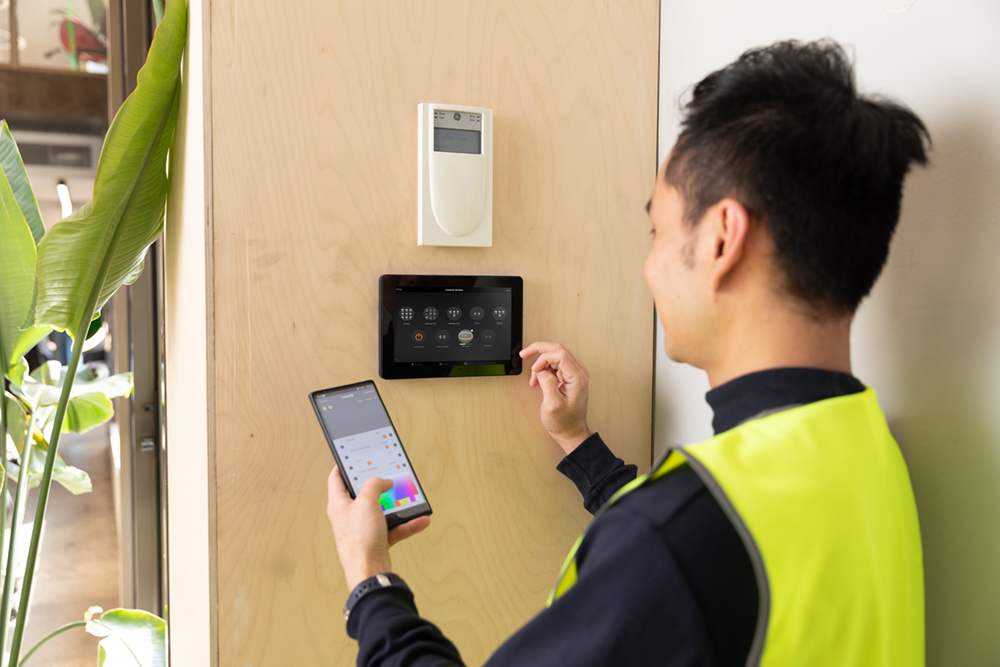
Smart Controls
Globally, building regulations are increasingly calling for the adoption of intelligent lighting and environment control systems. By incorporating smart lighting controls like Casambi and DALI, you can easily manage your lighting systems, not only reducing your expenditure but also contributing to a greener environment. These innovative control solutions grant you the power to customise your lighting according to your preferences. With Casambi, it’s as simple as using your smartphone thanks to its wireless Bluetooth capabilities. You can fine-tune the colour temperatures, adapt to various settings, and even schedule your daily lighting needs. This not only makes it a cost-effective solution but also positions it as a forward-thinking choice for sustainable lighting.
Through using intelligent controls such as sensors and zoning, you are able to illuminate the areas that are in use and turn lights off when no one is present, ensuring that you’re not wasting energy unnecessarily.

Energy Management
Widesky provides an innovative, technology-driven solution that empowers transparency and accountability when it comes to collecting and reporting sustainability data. By harnessing the power of our platform, we illuminate the previously hidden aspects of your environmental impact, allowing you to monitor and comprehend your energy consumption. With the goal of lowering carbon emissions and cutting down costs.
The Widesky platform gives consumers the ability to gain valuable insights and understanding of their emissions through intuitive data visualisation. For larger enterprises and prominent brands, Widesky serves as a comprehensive platform capable of hosting and managing extensive company data, facilitating effortless comparison and enhancing accessibility.

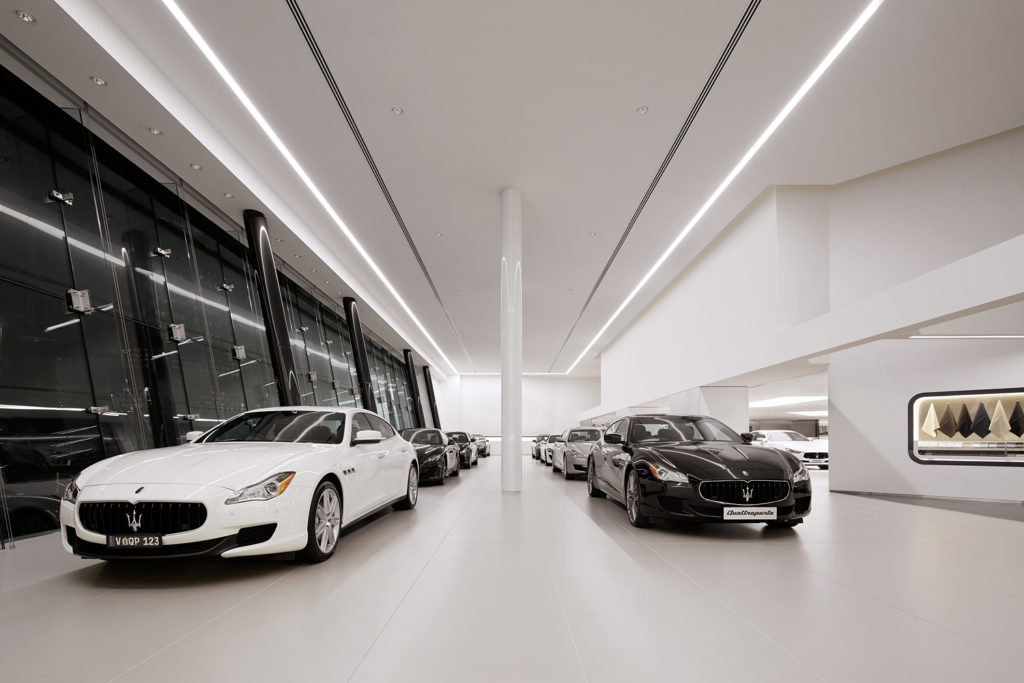
Why Lighting Design Matters More Than Ever in Today's Automotive Showrooms.
Lighting in car dealerships can be a challenging task. It can greatly impact sales, a customer’s experience at the dealership, safety and customer satisfaction. One of the biggest changes in the last few years has been the emergence of online shopping. In recent years, consumers have researched and shop for options online before deciding on what car to purchase. It’s imperative for the presentation and lighting of the car to live up to the customer’s expectations of what they saw on the website. This is why vehicles need to be showcased in the best possible light. Here are a few factors to consider when designing for your automotive dealership:
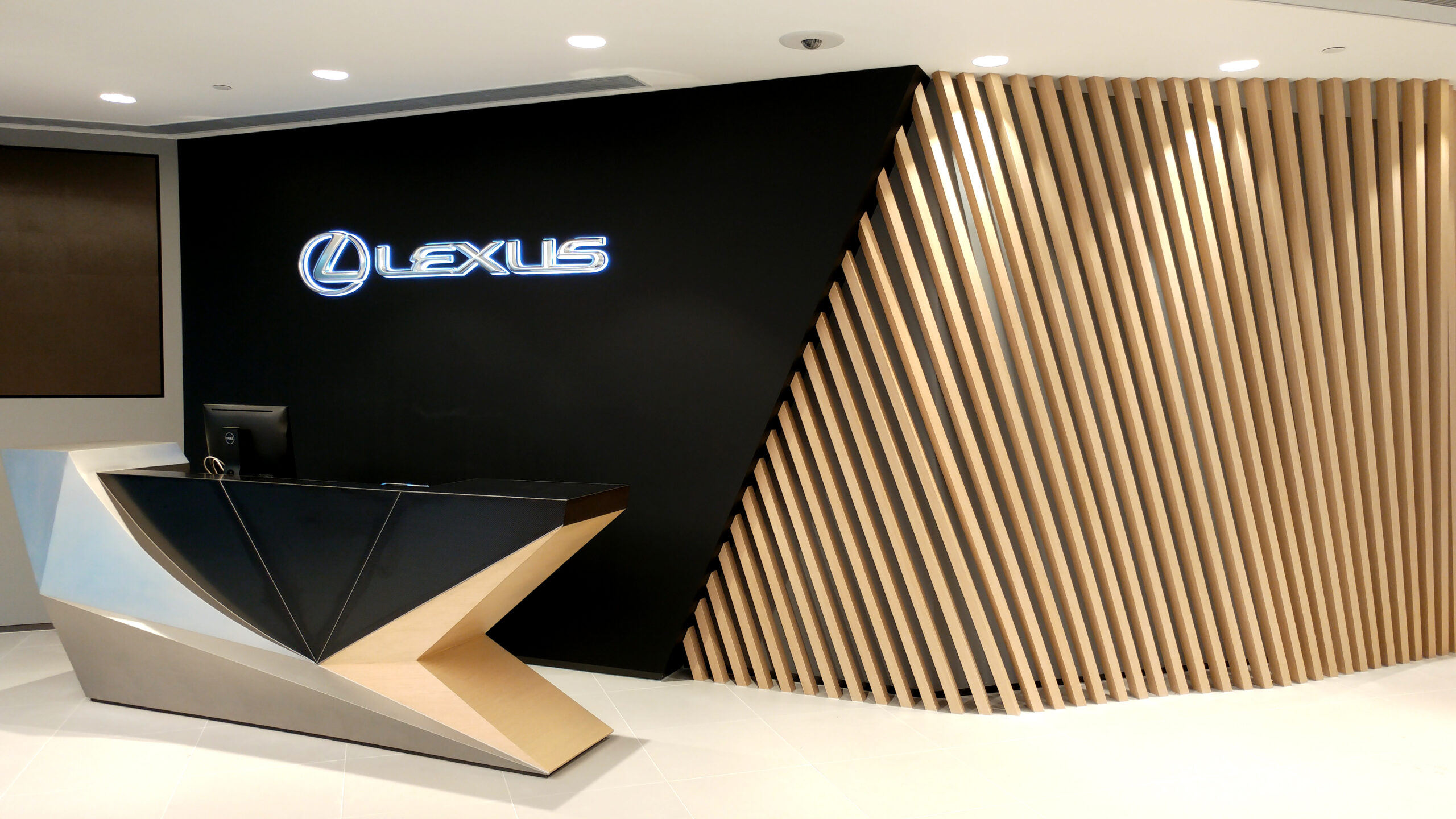
Branding Visibility for Automotive Showrooms
Today’s car buyers are familiar with and knowledgeable about the various car brands available on the market. Lighting can contribute to a brand’s overall impression and strengthen its relationship with the consumer. It can establish brand consistency throughout each of its store rollouts. Everything from the car showroom design to the lighting should reflect the brand image and be instantly recognisable to consumers when they enter the dealership.
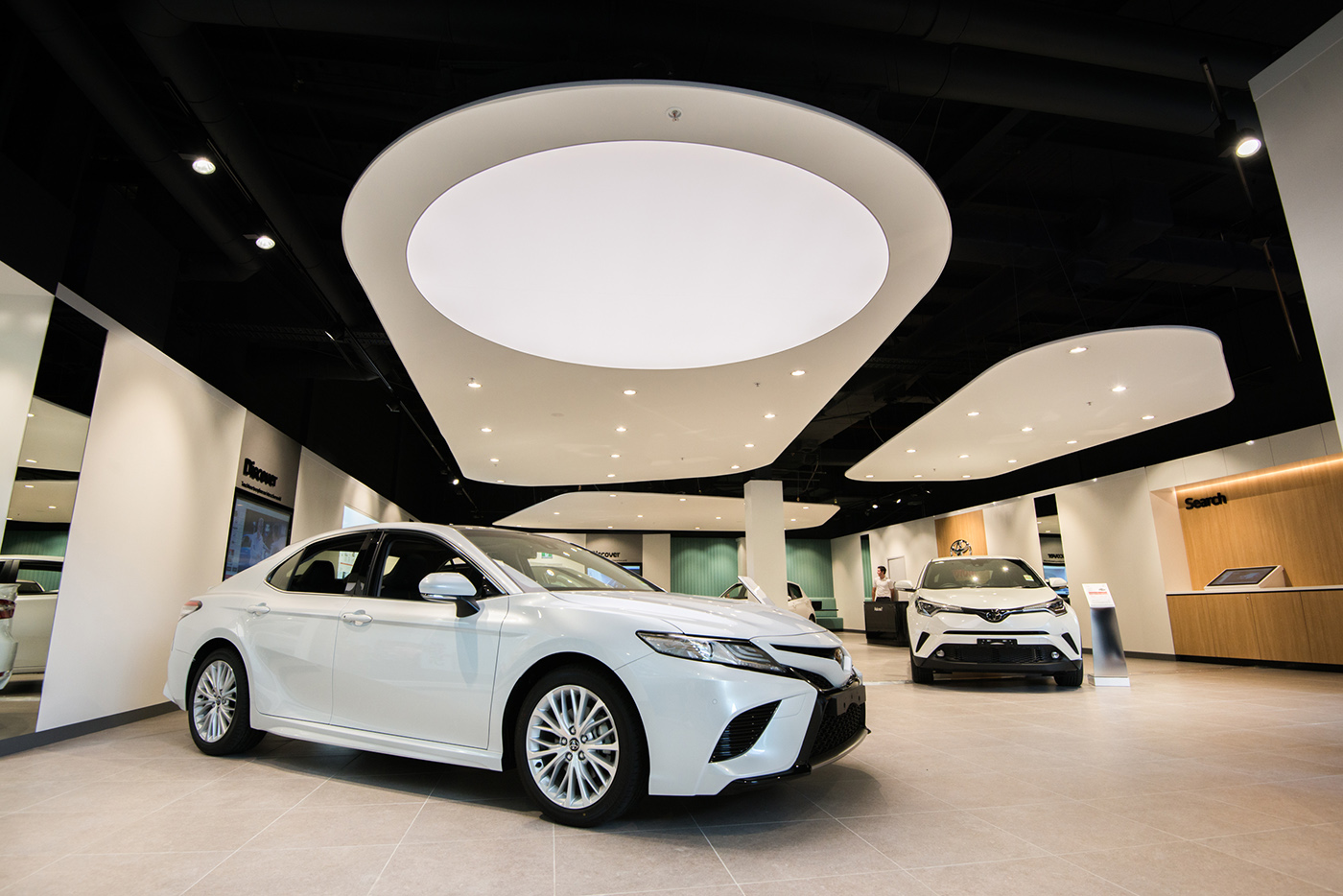
Automotive Showroom Presentation
The lighting you select can add value to a vehicle when modelled perfectly within the showroom. The vehicles need to look their best to attract customers and entice them to make a purchase. High illuminance levels are required to make the car models be viewed under perfect conditions. A diffused light is recommended as it can create a reflective, mirror finish on the vehicle and shows sleek lines.
Another factor to consider is the colour rendering of your light fixtures. We recommend using a high CRI to enhance the authentic appearance of the car. Customers can inspect the paint finishes and materials up close before making a decision. This can also establish trust between the customers and the brand.
High ceilings can be a challenge in large showrooms. Consider the amount of light required to illuminate the space adequately and whether to use low glare fitting. Using a combination of general lighting as well as spotlights can create contrast in the large sales floor space.
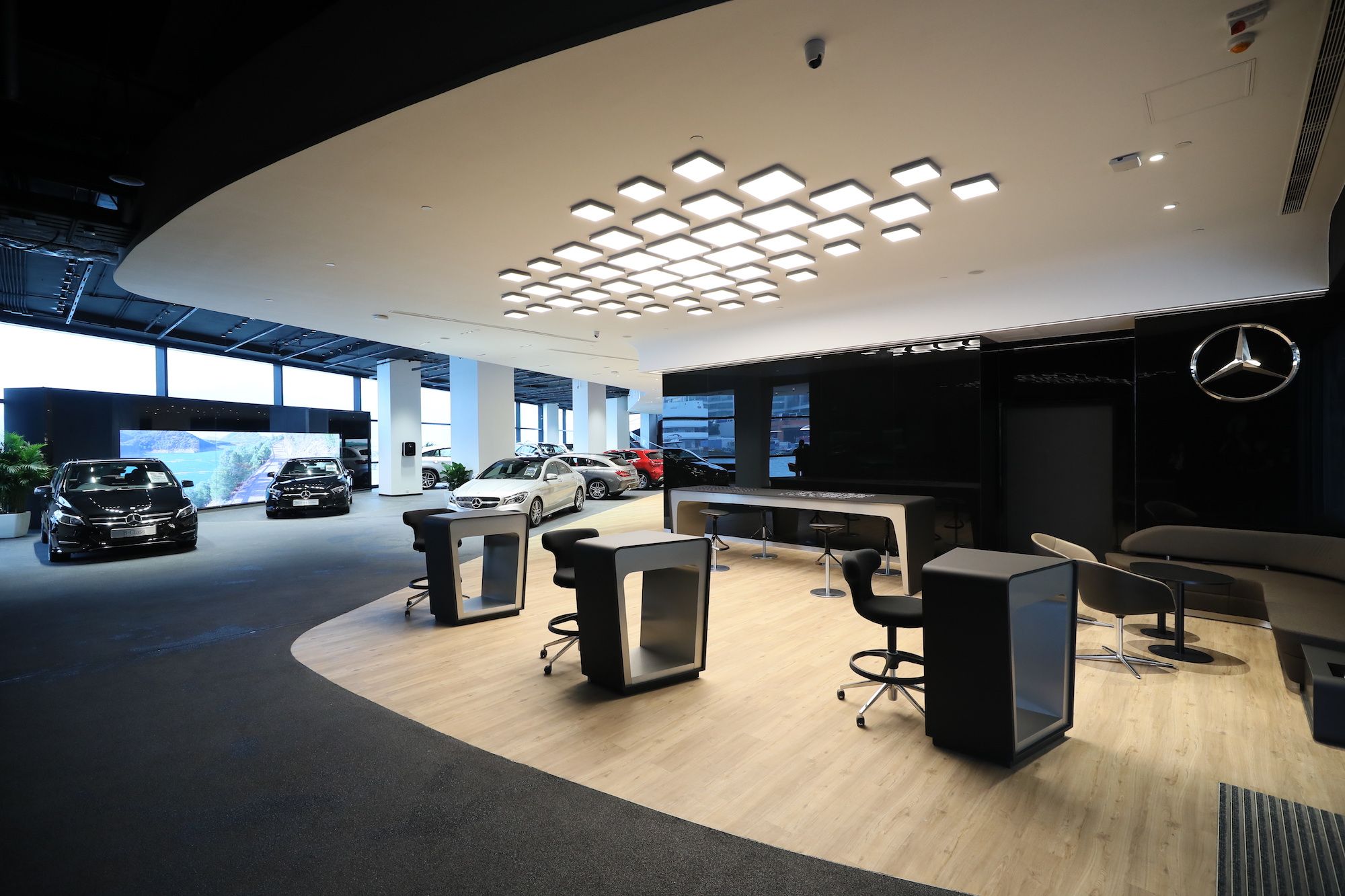
Accent Lighting in Automotive Showrooms
Adjustable spotlights are a popular versatile option to highlight featured cars. As display cars are often rearranged in showrooms, the flexibility of spotlights allows you to add and remove fittings as you see fit. When placed strategically, they can cast gentle shadows and eliminate glare for a more dramatic showroom look.
Ambience in Automotive Showrooms
A good ambience in any space can improve a customer’s morale and sense of well-being. Creating a comfortable and inviting lounge or waiting area space will encourage customers to be more communicative and enjoy their time while at the showroom. Consider using direct-indirect lighting pendants or linear extrusions above reception areas to create a cosy intimate atmosphere with your customers.
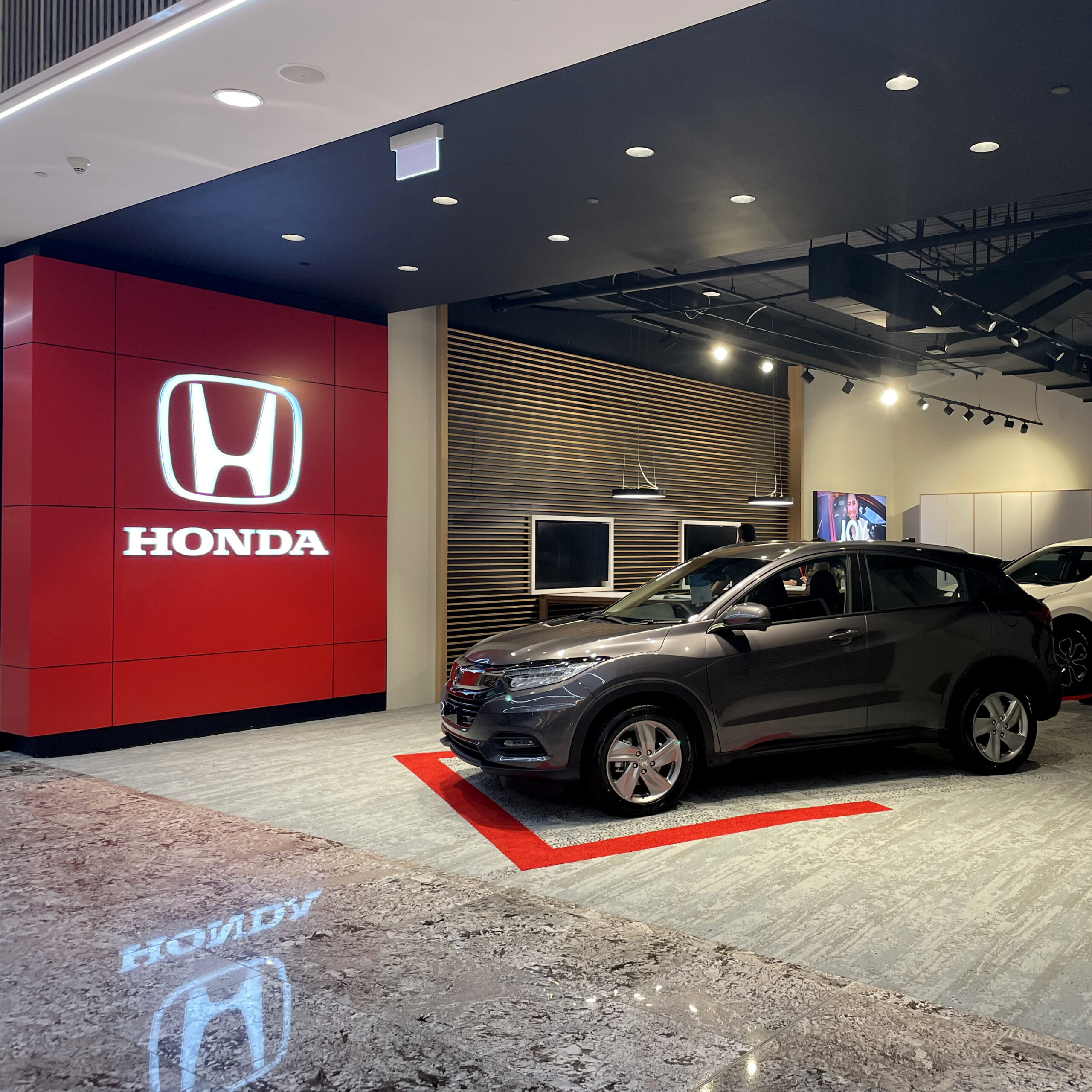
Automotive Dealerships in Shopping Centres
Dealerships are changing as more and more businesses move their operations into the familiarity of shopping centres. The informal setting puts the focus on customer experience and encourages them to engage with the products conveniently. Brands can build their brand presence and provide customers with an interactive experience. The advancements in technology have allowed automotive brands to showcase their cars innovatively.
Workshop Garage
Lighting in the workshop area of a car dealership should focus on functionality and safety. As it’s a space for mechanics to work, it needs to be illuminated properly to carry out repair and maintenance duties in a safe manner. Due to the type of work performed in this area, we recommend luminaires with an IP65 rating or higher since they are dust and water-resistant.
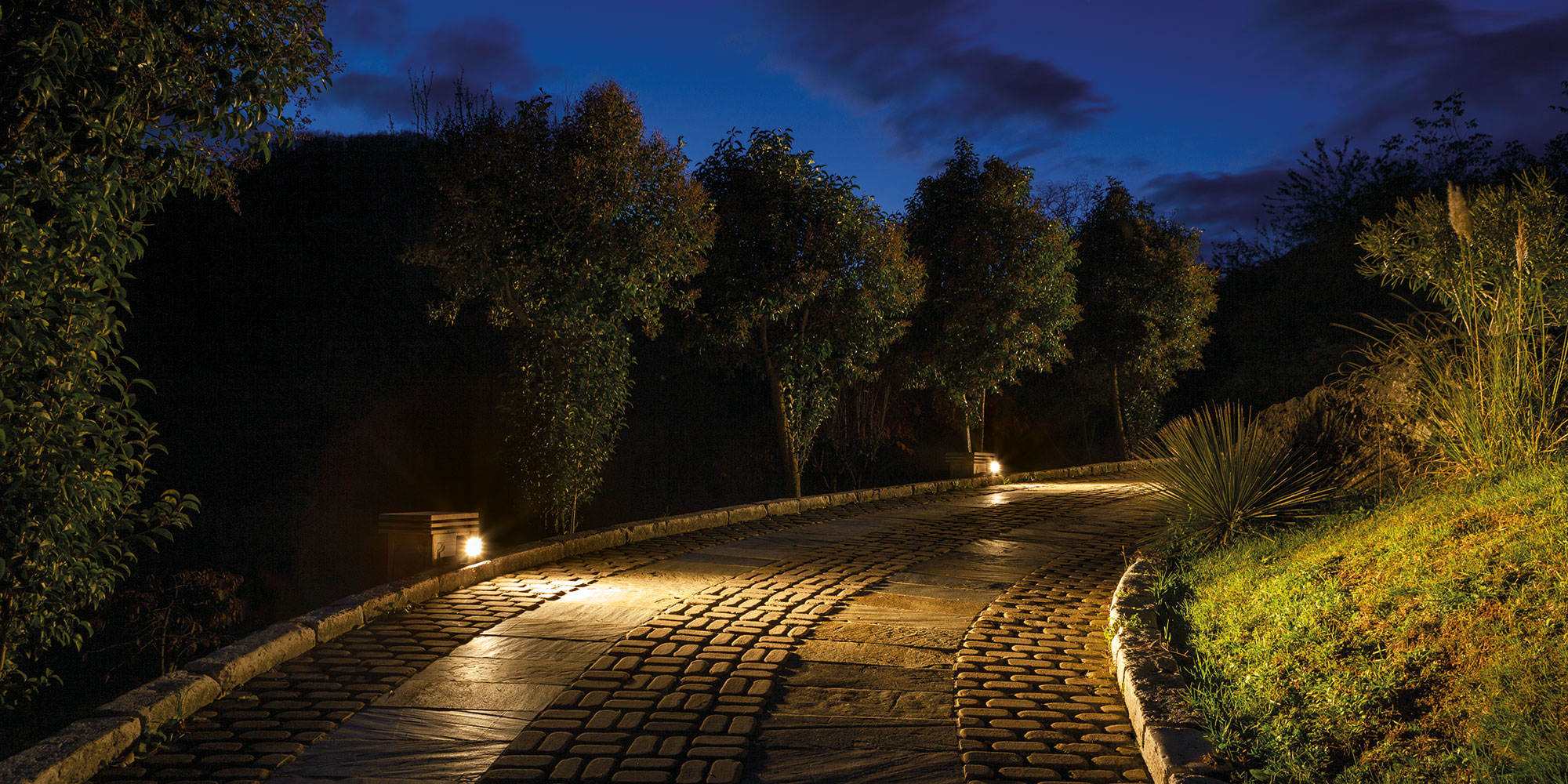
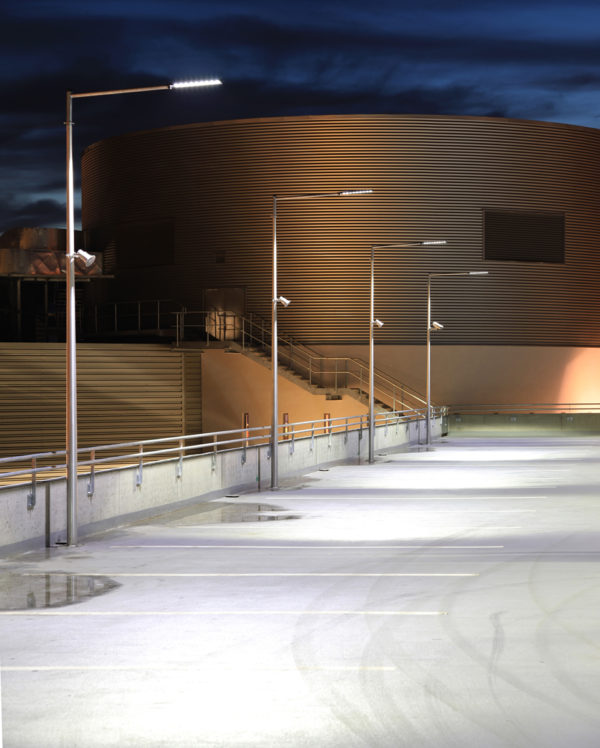
Security is more important than ever. When darkness falls, good lighting design is one of the most effective ways to ensure visibility and security. Exterior lighting plays a key role in determining how safe people feel. By using a combination of quality light fixtures and design approaches, you can achieve your desired results.
Well-illuminated spaces drastically minimise accidents, vandalism or break-ins from occurring. They can keep your space protected and provide safe passage for pedestrians, cyclists and drivers during the night.
Exterior light fittings should be robust and vandal resistant. They are often exposed to outdoor conditions making them vulnerable to deterioration. In addition to choosing suitable lights for your project, it’s important to consider good uniformity, the placement of the lights and energy efficiency in order to create a safe environment.
Commercial & Residential Properties
For commercial and domestic properties, outdoor lighting combined with a security or surveillance system is recommended. Although they are expensive, the sense of security far outweighs the cost. Not only does it assist you by identifying potential intruders, but it can also give the impression of someone at the property when there’s no one there. Good uniformed lighting minimises glare and makes it easier to see on a surveillance system. Key areas to consider lighting are the front entrance or porch, garage, car park or driveway, pathways, back entrances, landscaping and any outdoor areas such as a patio or pool. The lighting should be cohesive and compliment the style of the premise making it flow seamlessly together.
Roads, Car Parks & Pathways
There are several variables when it comes to car parks, pathways and road lighting. Unlike interior lighting, boundaries aren’t always defined and could hinder people’s safety. Appropriate exterior lighting can establish safe navigation from one location to another. It’s about finding a solution that not only works for the individual space but the surrounding areas as well. The key focus to consider is the location of the lights, circulation routes and how traffic will flow, glare, low maintenance and dimming and smart control options.
White light is recommended as the eye perceives it as more natural. You are able to recognise colour, shapes and faces better when it’s used. As drivers get older, they are more sensitive to glare and colour vision declines. Using white lights for roads, car parks and pathways ensures drivers, cyclists and pedestrians can assess and avoid hazards and risks in time.
Energy Consumption & Smart Controls
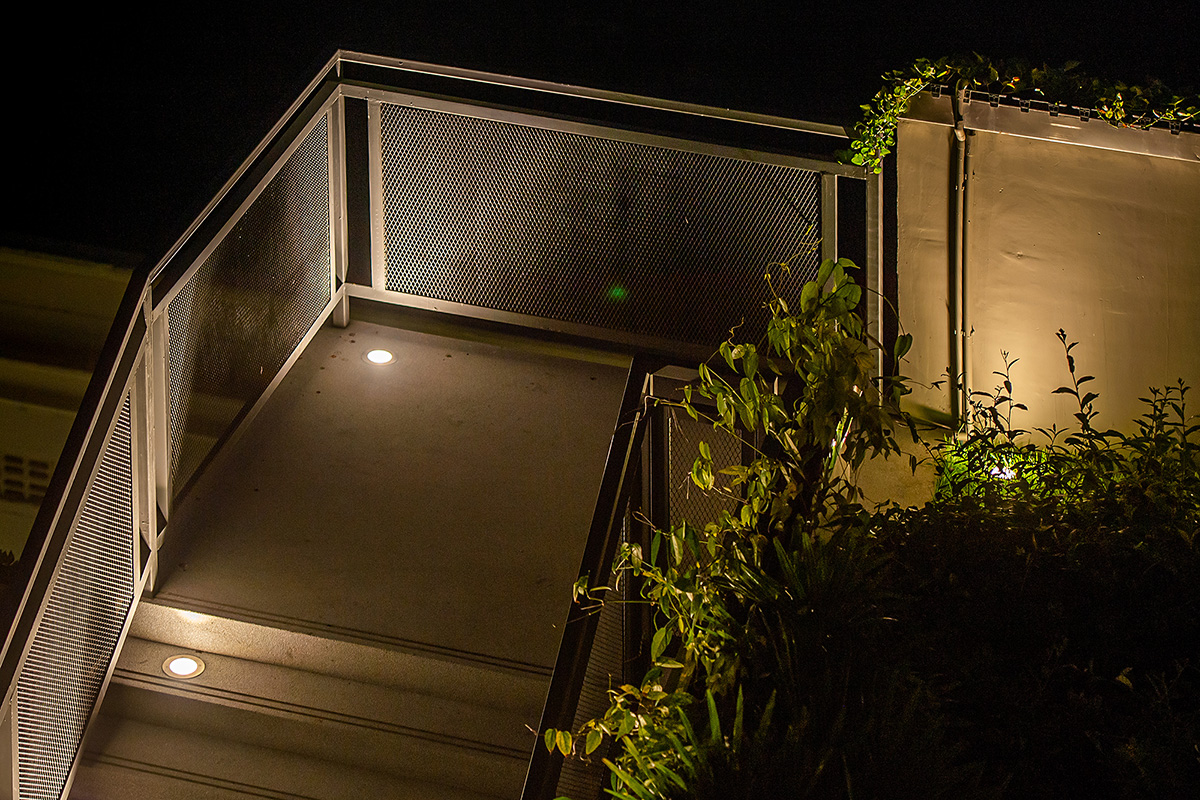
Integrating dimming, smart controls and emergency lighting into the design can contribute to energy efficiency and people’s safety. Motion sensors are a great investment around a property. They are triggered by movement and could alert you to potential trespassers in the area. Timers and photocell sensors are useful for lights on roads or car parks. The lights automatically turn off once sunlight is detected. This is particularly worthwhile during seasonal changes when it’s darker earlier on winter days. Lighting should be concentrated on the main areas to avoid unnecessary light spills. With appropriate lighting and emergency controls, lights can be used only when required allowing you to save money and significantly reduce energy consumption.
With security lighting, it isn’t always about having the brightest lights, it’s about having a suitable lighting solution that works in the exterior space. It goes without saying, it’s always advisable to have an alarm or surveillance system in place as an added form of security.
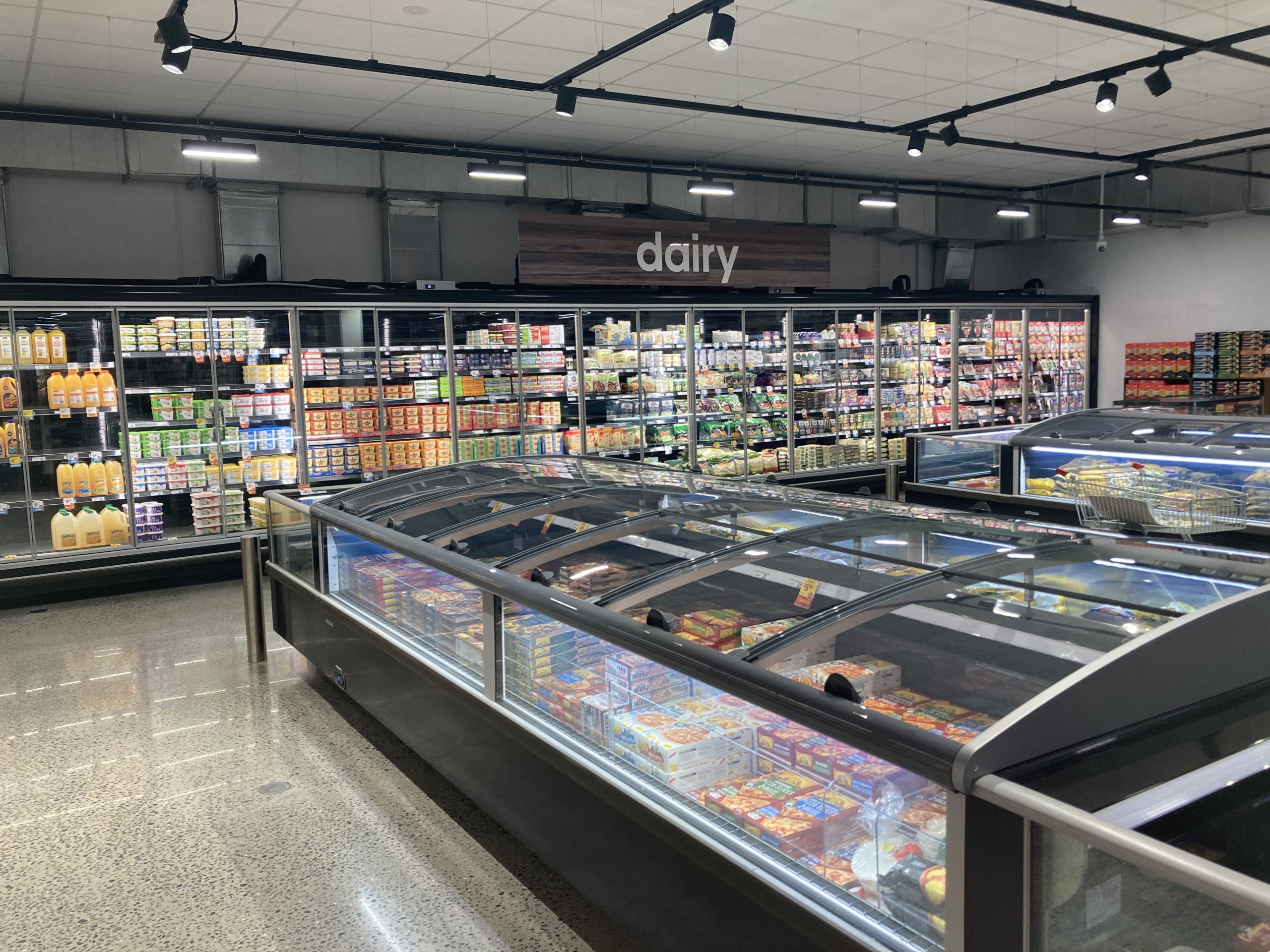
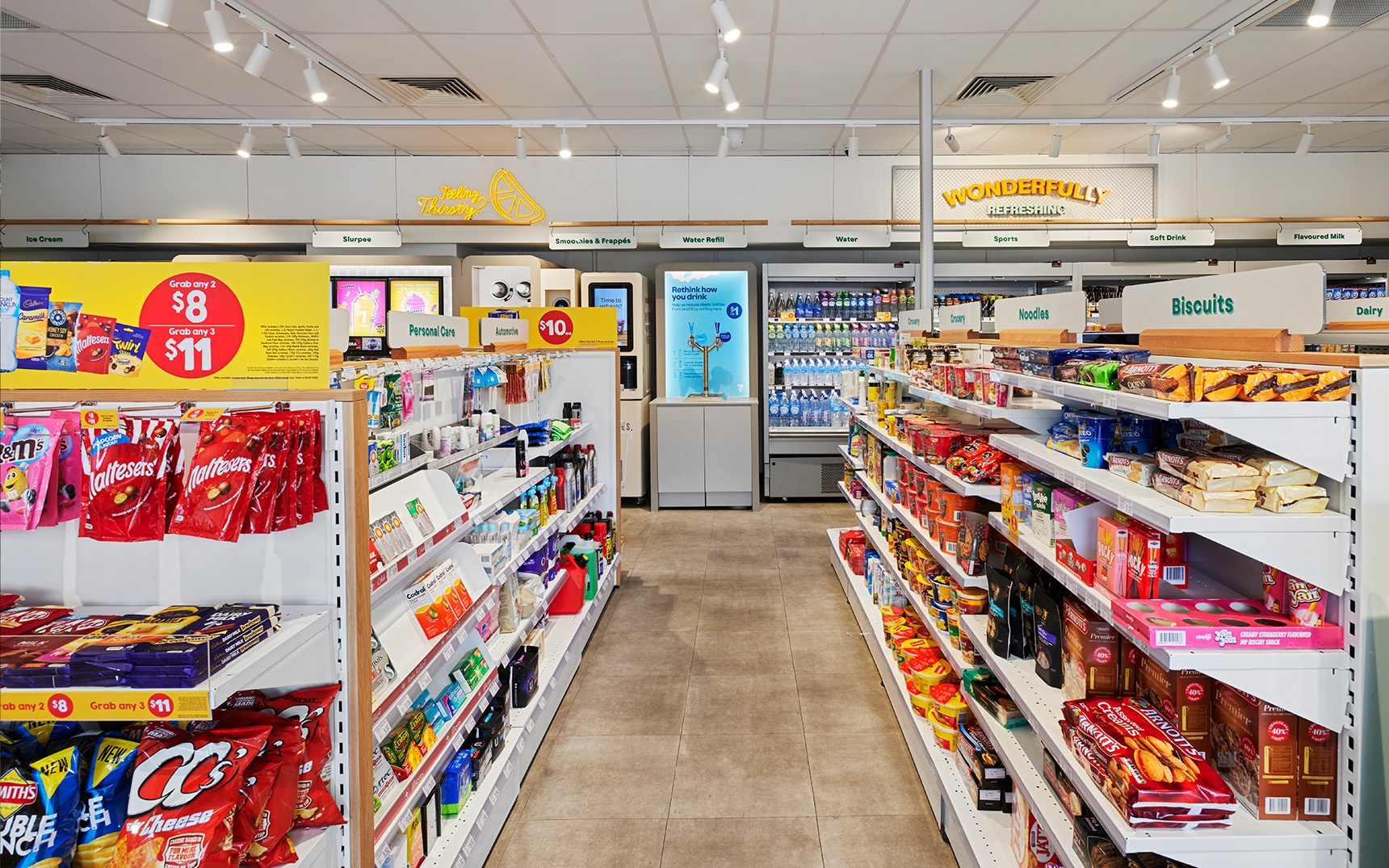
Supermarket lighting can create a positive shopping experience for customers and increase the workspace functionality for employees. As the range of products on offer becoming broader and more diverse, online shopping has become more accessible and convenient. This is why it’s important for supermarkets to consider lighting as an integral part of their store design. Different sections within the store have different requirements. We’ve put together a few key factors to consider when deciding what lighting works best for your store.
Fresh Produce
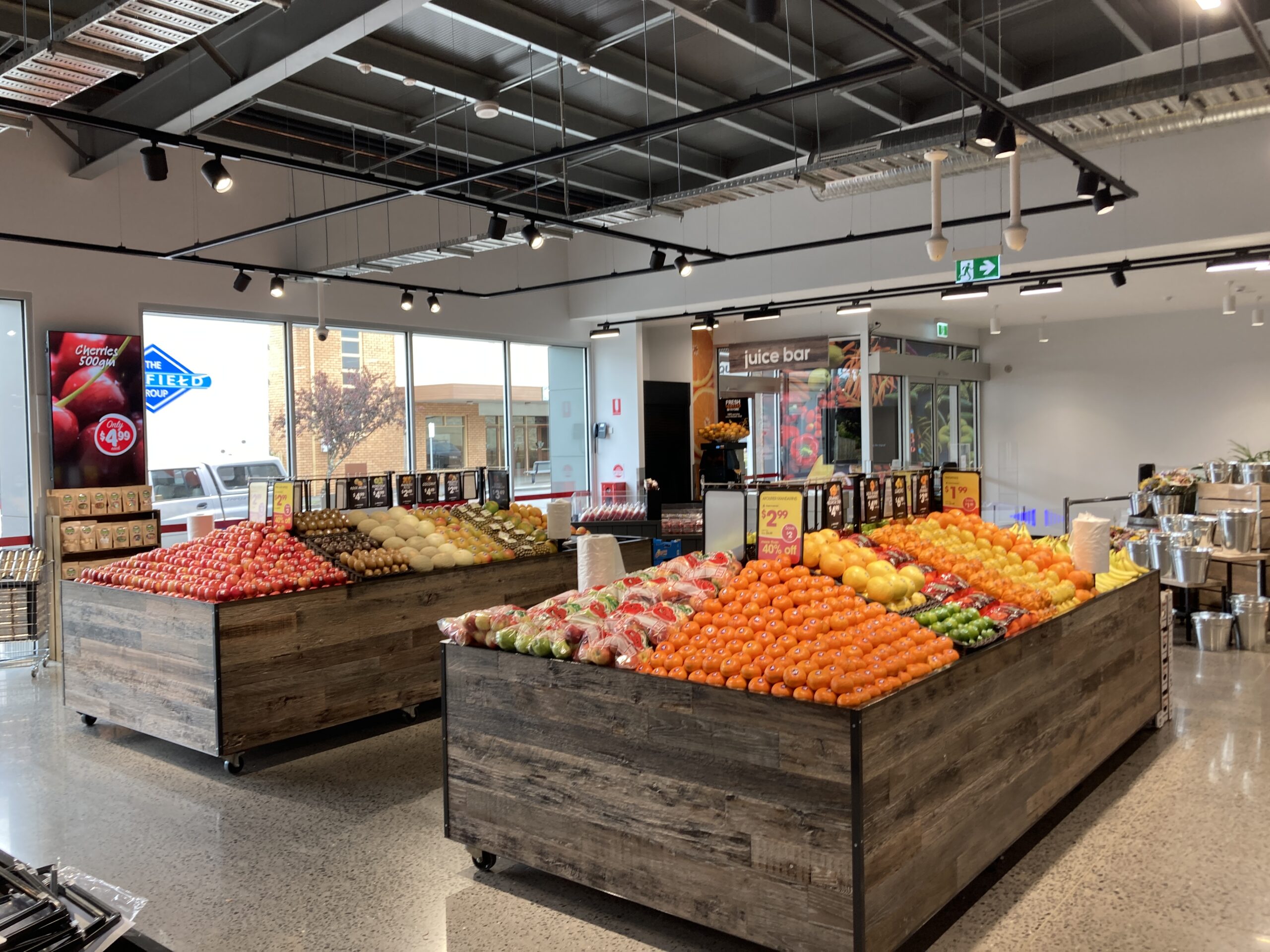
One of the most important areas to generate revenue in a supermarket is the fresh produce section. Often located at the entrance of the store, the fresh produce section should provide a welcoming and positive experience to entice customers to purchase goods.
Customers tend to purchase fresh produce more frequently than once a week due to its perishable nature. This results in higher product margins and a shorter shelf-life. It’s a key area for seasonal items and displaying the latest product offerings. Consider using track lights or pendants for accent lighting to indicate the important of the product displays. These can add depth and contrast to make the products stand out to the customers.
Colour is one of the main factors customers will use to determine the freshness and quality of the goods. Selecting the right colour temperature and colour rendering can create a natural fresh appearance. We recommend using a high-quality CRI to accurately represent the vivid colours of the produce making it look more authentic. This can also stimulate the appetite of customers and increase sales in this area.
Aisle Lighting
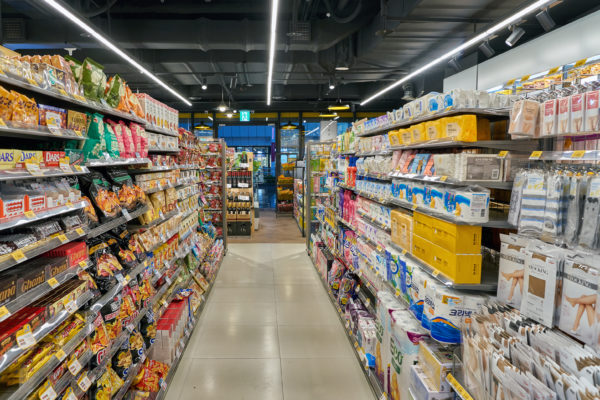
Supermarket aisles occupy a significant amount of floor space with a large proportion of products arranged on packed shelves. A good lighting system will provide product visibility and clearly guide customers within the space. We recommend using a continuous linear system in the centre of the aisle with uniformed vertical illumination. This allows customers to see the entire range of goods from the lowest to the highest shelf on both sides of the aisle. The lighting should be bright enough that customers can easily identify the products and distinguish the details between product offerings. Alternatively, track lights are another great solution offering flexibility that can be used for highlighting constantly changing product displays.
Checkout Registers & Point of Sale Stations
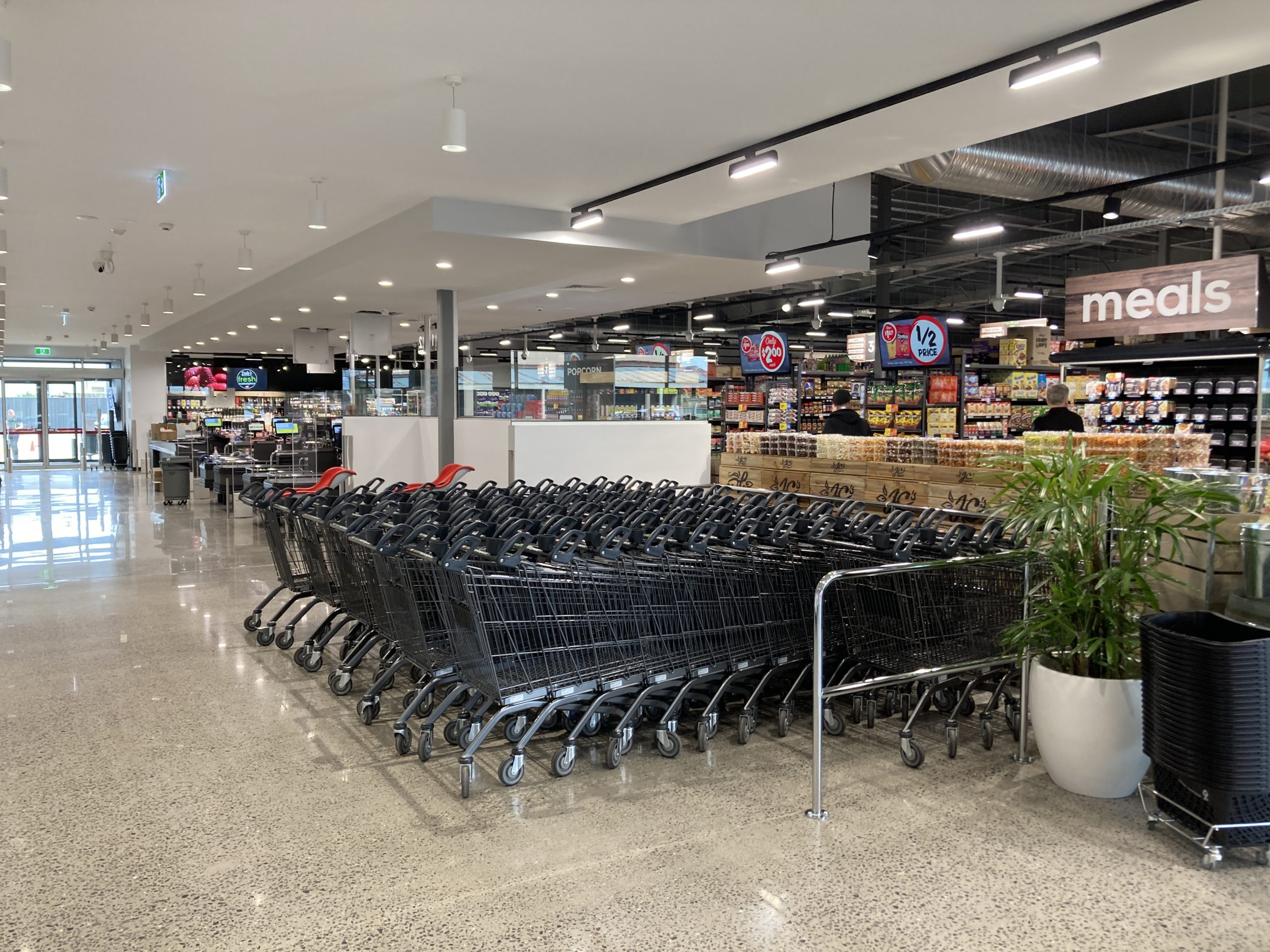
The checkout registers are a key zone for customers as they complete their purchases at the end of their shopping journey. The lighting should focus on functionality and be comfortable for workers as they perform their tasks. With staff looking at a screen for long periods of time, consider using low glare lighting to avoid eye strain and headaches. This is also a great opportunity for impulsive last-minute purchases, so ensure the registers and product displays are well illuminated.
Back of House
The back of house areas remains an important space for workers to complete their tasks. A key consideration for this area is functionality. Consider using low glare and comfortable task lighting for the offices, storerooms and refrigeration areas.
Similar to aisle lighting, the storeroom should be clearly visible for workers to easily identify where products are stored. In the refrigeration and food preparation areas, the lights need to be practical to allow workers to perform their tasks in a safe and efficient manner as well as meet food preparation standards.